Steer Clear

No time to read a long-winded BLOnG? Welcome to the Three-Second-Stop mini-Blog.

Today’s Three Seconds: Correct Hand Placement

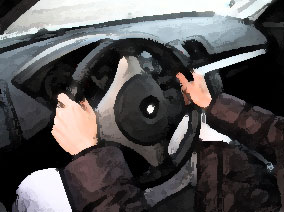
3 Second StopGrowing up you may have learned that “10 and 2” was the proper hand placement on the steering wheel. With the advent of airbags, it is now recommended that you hold the wheel at 9 and 3 o’clock or a little lower at 8 and 4 o’clock. This position gives you control of the vehicle and reduces the risk of hand and arm injury in the event the airbag deploys.

Festive Follies

Beware Intoxicated Drivers

The holiday season is right around the corner bringing many merry festivities with it.  Unfortunately this usually means an increase in drunken drivers on the road.  If you notice an impaired driver sharing the road with you, what should you do?

  1. Maintain a safe following distance.
  2. Do NOT try to pass or overtake a potentially intoxicated driver.
  3. If the car is behind you, try to turn onto another road.
  4. When safe, pull over and contact the police. Give them as much information as you can in regards to license plate number, vehicle description, location and behavior of the driver.

Most importantly, let the police handle the driver. Do not try to personally stop or detain the vehicle. Stay safe and have a great holiday season!

Wake Up Call

Driver Fatigue

You’ve been there before, driving and struggling to keep your eyes open. Drowsy driving can be as dangerous as drunk driving. When you are tired or fatigued, your reaction time, coordination, and vision all suffer.

In 2009, 2.5% (832) of fatal crashes in the United States were reported to involve drowsy driving. And 1.3% (72,000) of all injury crashes in 2009 had reports involving drowsy drivers.
(NHTSA – Traffic Safety Facts Crash Stats: Drowsy Driving)

So what can you do to combat drowsy driving before it begins?

  1. Get enough sleep regularly.
  2. Keep your eyes moving and continually scan the roadway to avoid ‘highway hypnosis’.
  3. Regulate the temperature in the car. Don’t let it get too warm. Open a window and get some fresh air moving.
  4. Take breaks. Get out of the car and move around.

Remember, if you start to feel fatigued behind the wheel, the best thing to do is to pull over in a safe place and get some rest.

Too Close for Comfort

No time to read a long-winded BLOnG? Welcome to the Three-Second-Stop mini-Blog.

Today’s Three Seconds: Tailgating

3 Second StopTailgating is the #1 cause of rear-end collisions. Also, following too closely is the #1 cause of collisions on the freeway. That’s why it is essential to leave plenty of space between you and the car ahead of you. Riding someone’s bumper is not only rude, it is also dangerous. There is no good reason to ever engage in tailgating so just don’t do it!

Silver Screen Autos

Name That Movie

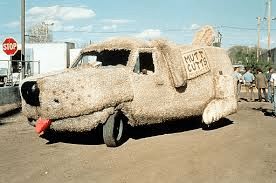
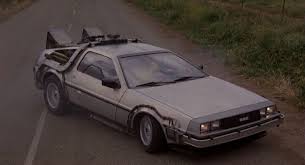
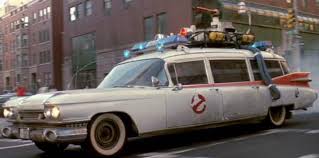
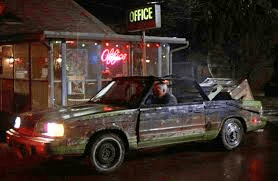
America loves cars. America loves movies. So what could be better than combining the two?  Take a trip down memory lane and see if you can name the movies that featured these memorable cars.  If you get stumped, there’s also a quote from each movie as an added clue.

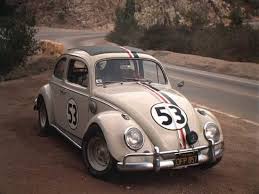
1963 Volkswagen Beetle


SIX:

“You don’t understand what happens, do you? They make ten thousand cars, they make them exactly the same way, and one or two of ’em turn out to be something special. Nobody knows why.”


Mutt Cutts Van


FIVE:

“Pullover!”  “No, it’s a cardigan but thanks for noticing.”


1981 DeLorean DMC-12


FOUR:

“The way I see it, if you’re gonna build a time machine into a car, why not do it with some style?”


1959 Cadillac Ecto-1

THREE:

“Everybody can relax, I found the car. Needs some suspension work and shocks. Brakes, brake pads, lining, steering box, transmission, rear-end.”


1978 VW Van


TWO:

“Oh my God, I’m getting pulled over. Everyone, just pretend to be normal.”


1986 Chrysler Town & Country


ONE:

“I know it’s not pretty to look at….but it’ll get you where you want to go.”


6) The Love Bug (1968) 5) Dumb & Dumber (1994) 4) Back to the Future (1985) 
3) Ghostbusters (1984) 2) Little Miss Sunshine (2006) 
1) Planes, Trains and Automobiles (1987)

New Law Alert

No time to read a long-winded BLOnG? Welcome to the Three-Second-Stop mini-Blog.

Today’s Three Seconds: Three Feet for Safety Act

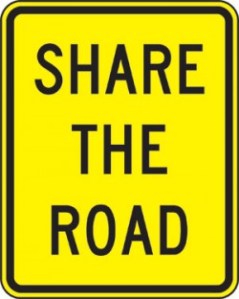
sharetheroad3 Second StopAs of September 16, 2014, the Three Feet for Safety Act (California Vehicle Code 21760) went into effect. This law concerns motorists sharing the road with bicyclists. If you are in a motor vehicle traveling the same direction as a bicyclist, you may not pass the bicyclist “at a distance of less than three feet between any part of the motor vehicle and any part of the bicycle or its operator.” If it is not safe to pass a bicyclist due to the traffic or road conditions, be sure to slow down and follow at a safe distance until you are able to safely pass them. If you fail to follow this new law, you could be fined $35; and if a collision occurs “causing bodily injury to the operator of the bicycle” you could be fined $220.

Whoa Nelly!

Vehicle Control and Recovery

Driving too fast for road and weather conditions can result in loss of car control. In today’s blog we will discuss what to do should you hydroplane or have a fishtail skid.

Hydroplaning occurs when you travel too fast on a wet road causing water to build up between your tires and the road. When you lose contact with the road you no longer have control of the car.

When you begin to hydroplane, do not slam on the brakes. Take your foot off the accelerator to gradually slow down, allowing your tires to regain contact with the road and restore vehicle control. Abrupt actions, like braking or yanking the steering wheel, can make the skid worse by putting your car into a spin.

A fishtailing skid is when the rear end of your car begins to slide back and forth because your back wheels lose traction with the ground. If you encounter a fishtailing skid you should:

  1. Take your foot of the gas pedal.
  2. Remain calm and keep a firm, steady grip on the steering wheel.
  3. Turn the steering wheel in the direction you want your vehicle to go.
  4. Try steering only enough to stop the skid, but you may need to counter-steer until you have regained control of the car.

Also, in both situations, if you are driving a car with manual transmission, the clutch should be disengaged when you take your foot off the accelerator.

It’s That Time Again…

No time to read a long-winded BLOnG? Welcome to the Three-Second-Stop mini-Blog.

schoolbuskids_webToday’s Three Seconds: School Bus Safety

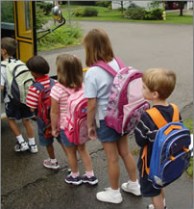
3 Second StopLaws vary by state, be sure to consult your local DMV for your state regulations. However in most states, when a school bus is stopped with red flashing lights to load or unload passengers, vehicles traveling in either direction are required to stop. They must remain stopped until the lights are no longer flashing. Generally the only exception is for traffic traveling in the opposite direction of the school bus on a road divided by a physical barrier.

Get Your Kicks

route-66-110606_640On Route 66

We’ve all heard it, the iconic song about the iconic cross-country highway. For those you who have never traveled the now lonely road, let’s make a few virtual stops on this historic route spanning over 2000 miles from Chicago, Illinois to Santa Monica, California.

Big Blue Whale Catoosa OK
The Blue Whale can be found in Catoosa, OK. This huge structure is 80 feet in length and 20 feet tall. Built by Hugh S. Davis in 1972 as an anniversary gift for his wife, Zelta, it was a great place to cool off after a hot day on the road. The attraction closed in 1988 but was restored and reopened in 1997.

800px-Wigwam_Motel,_Holbrook,_AZ_04048u_edit
If you find yourself in Holbrook, AZ, make a stop at the Wigwam Motel. You can even spend a night in a “teepee.” Owner and operator Chester E. Lewis, who ran the business until he sold it in 1974, completed construction of Wigwam Village Motel #6 in 1950. In 1988 Lewis’ wife and children bought and re-opened the motel.

Santa_Monica_Harbor
You’ll come to the end of the road at Yacht Harbor Pier in Santa Monica, CA. The Santa Monica Pier had a rich history of its own before it was officially assigned the West Coast’s conclusion of Route 66 in November 2009. The first pier was constructed in 1909 and has been altered, enhanced and renovated a few times since.

Driving with Diligence

Collision Prevention

hands on steering wheelsRoad safety starts with you, the driver. Here are a few defensive driving pointers to help you stay safe and sound while on the go.

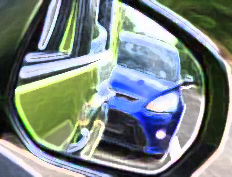
Scan the road ahead looking for possible hazards so you have time to react to them. Also, regularly check your mirrors so you know at all times what potential obstacles surround your vehicle.  If your view is blocked by a hill or a curve proceed with caution.

Keep a space cushion of 3-seconds between you and the vehicle you are following. Sometimes you may need to add additional space, such as when following large trucks or motorcycles, and when the weather and/or road conditions are less than ideal. Also, keep a space cushion to the side and rear of your vehicle so that you have room to maneuver should an obstacle present itself.

Follow the basic speed law; don’t drive faster than the conditions of the road and weather allow. This may mean you need to drive slower than the posted speed limit. You must decide what the safest speed is under the current conditions.

Being a responsible driver includes being fully aware of all traffic laws, right-of-way rules, and street signs.  Many drivers make poor driving decisions because they don’t know the law.

Avoid distractions. A distraction can be anything that takes your mind off of the task of driving, whether it’s a cell phone, the radio, passengers, even food. Driving has to be the number one priority every time you are behind the wheel.

Last, but not least, don’t drive under the influence, whether it is alcohol or prescription drugs from your doctor. Even a small amount of drugs or alcohol can affect depth perception, speed perception, coordination, reaction time and vision, all of which are essential to driving.