Get Your Kicks

route-66-110606_640On Route 66

We’ve all heard it, the iconic song about the iconic cross-country highway. For those you who have never traveled the now lonely road, let’s make a few virtual stops on this historic route spanning over 2000 miles from Chicago, Illinois to Santa Monica, California.

Big Blue Whale Catoosa OK
The Blue Whale can be found in Catoosa, OK. This huge structure is 80 feet in length and 20 feet tall. Built by Hugh S. Davis in 1972 as an anniversary gift for his wife, Zelta, it was a great place to cool off after a hot day on the road. The attraction closed in 1988 but was restored and reopened in 1997.

800px-Wigwam_Motel,_Holbrook,_AZ_04048u_edit
If you find yourself in Holbrook, AZ, make a stop at the Wigwam Motel. You can even spend a night in a “teepee.” Owner and operator Chester E. Lewis, who ran the business until he sold it in 1974, completed construction of Wigwam Village Motel #6 in 1950. In 1988 Lewis’ wife and children bought and re-opened the motel.

Santa_Monica_Harbor
You’ll come to the end of the road at Yacht Harbor Pier in Santa Monica, CA. The Santa Monica Pier had a rich history of its own before it was officially assigned the West Coast’s conclusion of Route 66 in November 2009. The first pier was constructed in 1909 and has been altered, enhanced and renovated a few times since.

Driving with Diligence

Collision Prevention

hands on steering wheelsRoad safety starts with you, the driver. Here are a few defensive driving pointers to help you stay safe and sound while on the go.

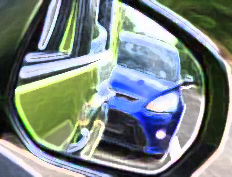
Scan the road ahead looking for possible hazards so you have time to react to them. Also, regularly check your mirrors so you know at all times what potential obstacles surround your vehicle.  If your view is blocked by a hill or a curve proceed with caution.

Keep a space cushion of 3-seconds between you and the vehicle you are following. Sometimes you may need to add additional space, such as when following large trucks or motorcycles, and when the weather and/or road conditions are less than ideal. Also, keep a space cushion to the side and rear of your vehicle so that you have room to maneuver should an obstacle present itself.

Follow the basic speed law; don’t drive faster than the conditions of the road and weather allow. This may mean you need to drive slower than the posted speed limit. You must decide what the safest speed is under the current conditions.

Being a responsible driver includes being fully aware of all traffic laws, right-of-way rules, and street signs.  Many drivers make poor driving decisions because they don’t know the law.

Avoid distractions. A distraction can be anything that takes your mind off of the task of driving, whether it’s a cell phone, the radio, passengers, even food. Driving has to be the number one priority every time you are behind the wheel.

Last, but not least, don’t drive under the influence, whether it is alcohol or prescription drugs from your doctor. Even a small amount of drugs or alcohol can affect depth perception, speed perception, coordination, reaction time and vision, all of which are essential to driving.

Buckle-Up Back There

No time to read a long-winded BLOnG? Welcome to the Three-Second-Stop mini-Blog.

Today’s Three Seconds: Seat Belts All Around

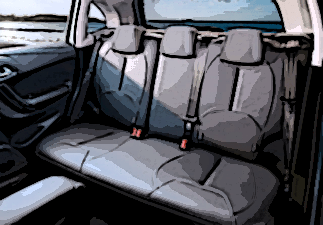
backseat23 Second StopYou may be surprised to know that riding in the back seat of a vehicle without a seat belt is dangerous. In fact any unbelted person not only endangers themselves, but greatly increases the risk of death and injury to other vehicle occupants. Currently not every state in the US has laws requiring use of backseat restraints; don’t let this stop you from strapping in next time you ride in the back.

Give Big Rigs Their Due

Share the Road

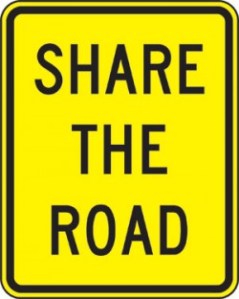
share the roadSemitrailers operate a little differently than your car, so let’s take a moment for a few friendly reminders on sharing the road with large trucks.
Give them extra space in several ways. Don’t cut in front of a large truck. They are heavier and take longer to stop than the average car. You should see the front of the truck in your rearview mirror before moving into the lane. Also, when following a trailer truck the truck’s size can block your view; increase your following distance so that you have more reaction time and room to brake.

Stay out of the truck’s blind spots. Large trucks have large blind spots on all sides. If you can’t see the driver in truck’s side mirror, then the truck driver can’t see you. If you are going to pass a semi, do so quickly and on the left side. Lingering in a truck’s blind spot is dangerous.

Pay close attention to a trucks turn signals. Be aware that rigs need extra room to maneuver turns. They tend to swing wide to execute right turns. Don’t squeeze between the curb and the truck; you could end up getting crunched.

Keep these tips in mind next time you are on the road and remember in a collision with a big rig you’ll find you are the loser.

Way of the Future

Solar Roadways

Parking_lot_east

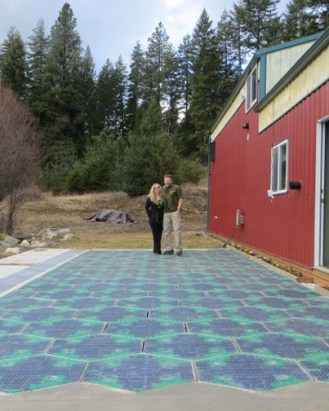
The Brusaws with their Solar Parking Lot Prototype

Julie and Scott Brusaw, a couple based in Idaho, have been developing a Solar Roadway system that could have a wide range effect on our way of life.  The proposed intelligent roadway besides harvesting energy would potentially offer addition advantages such as LED lights with numerous configurations and colors that would eliminate the need for painted road markings; heated panels in colder climates that would keep the driving surface clear of snow and ice removing the need of snow plows and sanding crews; modular panels that could be removed and replaced by a technician easily reducing the traffic congestion due to road repairs.  There are also projections of increased use of Electric Vehicles with the ability to charge while driving.  The suggested benefits would also change the way in which we power our homes and businesses and the solar roadway technology could be used in parking lots, sidewalks, ideally any surface that is currently paved for walking or driving.  The possibilities are abundant and exciting.

Source: www.solarroadways.com

Who Goes First?

No time to read a long-winded BLOnG? Welcome to the Three-Second-Stop mini-Blog.

Today’s Three Seconds: Knowing Your Right-Of-Way

right-of-way3 Second StopAn intersection without a stop or yield sign could present a little confusion. Make sure to slow down and be prepared to stop. Yield to vehicles already in the intersection or entering it in front of you. If you and another driver reach the intersection at the same time, yield if the car is on your right.

Go Speed Racer… No!

Risky Business

In 2012 roughly 92 people died in motor vehicle crashes each day according to the National Highway Traffic Safety Administration. 30% of these deaths involved speed-related traffic crashes.

Speeding is generally viewed as dangerous driving behavior, but this doesn’t seem to keep 75% of drivers from speeding regularly. The most common forms of speeding are driving too fast for the conditions, driving above the posted speed limit and racing. For every 10 mph over 50 mph that a vehicle travels, the chance of death or serious injury doubles.Speeding Tickets

Most of the time, we are speeding to save time. The truth is we don’t save as much time as we would like to think. If you were traveling at 65 mph over 20 miles instead of 55 mph you would save only about three and a half minutes! And if speeding doesn’t lead to a collision, you may still end up with ticket which is a whole other set of problems to deal with.

So, next time you’re tempted to put the pedal to the medal, ask yourself… “Is it worth it?”

Bridge the Gap

Can You Name These Memorable Bridges? Part II

Bridges are wonders of engineering and architecture. They are together beautiful and functional. Can you name any of these bridges from around the world, both near and far?

Pont_de_Triana
FOUR: Construction on this bridge was completed in 1852 making it the oldest iron bridge maintained in Spain. The design was similar to the Paris Carrousel Bridge featured in a painting by Van Gogh in 1886. Commonly referred to as Puente de Triana, it is actually named after the reigning queen at the time of its creation.


Howrah_Bridge_Kolkota
THREE: This bridge is found in West Bengal, India and has become a symbol of Kolkata (Calcutta). Constructed from 26,500 tons of steel the entire structure is erected using rivets. The cantilever and suspended span bridge was renamed Rabindra Setu in 1965, but is still widely known as…


Throgs_Neck_Bridge
TWO: This suspension bridge turned 50 years old in 2011 and was built to alleviate some of the traffic on the Whitestone Bridge. Located in New York City, its total length is 2,910 feet with the longest span at 1,800 feet.


Arthur_Ravenel_Bridge
ONE: Located in South Carolina, this cable-stayed bridge replaced two outdated cantilever truss bridges. Mindful of the locale’s history, the bridge was engineered to endure hurricane force winds and earthquakes as well as potential shipping accidents.


Check out: London Bridge Is Falling Down… Can You Name These Memorable Bridges? Part I

4) Puente de Isabel II 3) The Howrah Bridge 2) Throgs Neck Bridge 
1) The Arthur Ravenel Jr. Bridge 

Driving with ABS

No time to read a long-winded BLOnG? Welcome to the Three-Second-Stop mini-Blog.

Today’s Three Seconds: Anti-Lock Brakes (ABS)

How does ABS break system work3 Second StopYour car’s ABS helps you stop shorter and maintain steering control while braking, especially on slippery surfaces. The key to proper ABS success is driver education.
In an emergency, or ‘panic stop,’ you should press your brake pedal once, holding it firmly. Never pump the brakes — Anti-lock brakes can sense when your wheels are locked and electronically pump your brakes 10 times faster than you — This is what causes the vibration in your brake pedal and the ratcheting noise when the ABS is engaged. Whenever you feel the brake pedal pulsing, press even harder.

Spring Break with a Plan

Fun, Sun and Safety

For many families it is Spring Break which means it’s time for a family vacation. Here are a few tips to make your travel plans a little safer and less stressful.

road-trip

  • Get a Tune Up. Make sure your car is in good working order before hitting the road.
  • Pack Thoughtfully. Keep safety and economic benefits in mind when you are loading up the family van. Also, prepare for the unexpected by packing an auto safety travel kit with useful items in the event you run into a problem.
  • Research Your Route. Find out before you leave what the road and weather conditions will be like.
  • Don’t Be In a Rush. Allow enough time to get to your destination safely. Planning ahead will help avoid aggressive driving and road rage.
  • Stay Connected. Let a friend or other family member know your travel plans.

All that is left to do now is sit back and enjoy the ride!