Penny for Your Peace of Mind?

The Penny Test

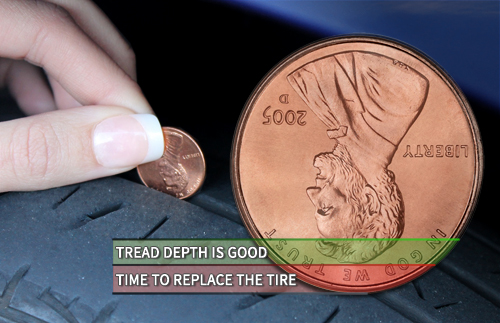
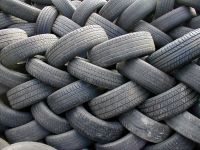
Tire tread is important. Worn tires can’t grip the road properly leading to slips and skids. Fortunately, there’s an easy way to check your tire tread depth and all you need is a penny!

Here’s what you do: Place a penny into a tread groove on your tires with Lincoln’s head pointed down. A newer penny where Lincoln’s head isn’t worn will work best. If part of his head is covered by the tire tread, you’re good to go. If you can see all of Lincoln’s head, then it’s time to replace the tire. Repeat the test in multiple grooves and on each tire to check for uneven wear.

So there you have it, a simple way to keep an eye on the health of your tires.

Renewed Life

Used Motor Oil Recycling

Did you know motor oil doesn’t wear out? It just gets dirty. Which means it can be recycled and reused in several ways. All over the U.S. there are used oil collection locations available. These organizations allow the average Joe to dispose of old motor oil, which in turn keeps that oil out of our ground water and waterways. Next time you change the oil in your car, or even your lawnmower, collect the dingy oil in a metal or plastic container to be recycled. These collection centers should also accept old oil filters and bottles. To find a collection center near you, visit http://search.earth911.com/american-petroleum-institute.php.
Another quick tip to keep oil out of our water is don’t try to hose down spilled oil. Rather use absorbent towels to wipe up the mess.

Slip Risk

No time to read a long-winded BLOnG? Welcome to the Three-Second-Stop mini-Blog.

Today’s Three Seconds: Freshly Wet Roads

3 Second Stop
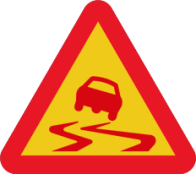
As you may already know, wet roads require extra care when driving. However, were you aware that many roads are the most slippery when it first starts to rain, particularly if it hasn’t rained in a long time? When rain first begins to fall, the accumulated oil on the road will be loosened and mixed with the water, making it even slicker than after it has been raining for a while.

To-and-Fro: Stay Safe as You Go

School Bus Passenger Tips

School is starting all across the country. Now is a good time to teach, or remind, your little ones about school bus safety.
  1. When waiting at the bus stop, stay on the sidewalk, away from the road. Pay attention to what is going on around you. Don’t get distracted by playing with your friends.
  2. When getting on the bus, find a seat promptly and sit down facing the front of the bus. Sit still and talk quietly with your neighbor. Don’t distract the bus driver with a lot of ruckus. Let them do their job safely driving you to school.
  3. When exiting the bus, be aware of passing cars. Put distance between you and the bus so the bus driver will be able to see you. Stay away from the wheels of the bus and remember to cross in front of the bus, not behind it.

Lights Out

No time to read a long-winded BLOnG? Welcome to the Three-Second-Stop mini-Blog.

Today’s Three Seconds: Traffic Signal Blackout

3 Second StopIf a power outage occurs and all the traffic signals are not working properly, proceed with caution and handle the intersection as you would an intersection with All-Way STOP signs. Remember your right of way protocol. If you and another vehicle on a cross street arrive at the intersection at the same time, then the vehicle on the left must let the vehicle to the immediate right go first.

What’s Going on Back There?

Taking in the Big Picture

A big part of defensive driving is scanning the road. Not just looking for hazards ahead of you, but also being aware of what is going on to the sides and behind you as well. When scanning, your eyes are continuously moving from side to side, ahead and in your rear-view mirrors. Take short quick glances to take in the big picture and be aware of and regulate potentially hazardous situations before you find yourself in a predicament.

First off, you should make sure to properly adjust your seat and mirrors before you start driving. You want to make sure you have as wide a field of vision as possible to the back of your vehicle when looking into the rear-view and side-mirrors.

Second, remember these three instances where checking traffic behind you is of great importance.

  1. Backing: When backing it is best to back up as little as necessary as you are more likely to hit something because your visibility is limited. Before you back up check your mirrors and look over your shoulder as you reverse. Keep your speed as slow and safe as possible.
  2. Changing lanes: Before you begin your lane change, always look over your shoulder after checking your mirrors to confirm that there are no vehicles hiding in your blind spot. This is also good to remember as part of moving over to curbside park or preparing to make a right turn.
  3. Slowing down quickly: Stopping suddenly can put you at high risk of being rear ended by another motorist. Make sure to check your rear-view mirror when forced to brake harder than usual. This is a good reason to have a safe space cushion between you and the vehicle in front of you.

Get in the habit of utilizing your rear and side view mirrors more consistently. The greater your ability to comprehend what is going on around your car, the safer it will be for you to drive.

All Shook Up

Driver Emotion

Driver impairment is not only caused by drugs and alcohol. Our driving is impaired anytime our ability to operate a vehicle is compromised. Because emotions can govern our behavior to a large extent, they too can diminish our driving capabilities. Emotional impairment can affect our ability to recognize risks and quickly react.
Here are some helpful tips to help regulate our emotions while driving.

  • Do not take the aggressive actions of other drivers personally.
  • Cool off when angry or frustrated.
  • Don’t drive when feeling upset, frustrated, depressed or angry.
  • Don’t have emotional conversations while driving.
  • Stay focused on the driving task.
  • Turn a negative driving situation into a positive situation.
  • Demonstrate the kind of courtesy you would like to receive from others.

Safe driving requires our focus at all times. When behind the wheel, try to ‘shelve’ problems temporarily. Instead, concentrate on the driving tasks at hand. If unable to do that, then it is best to wait to drive until our emotions are under control.

Save Gas… Check Your Tires

No time to read a long-winded BLOnG? Welcome to the Three-Second-Stop mini-Blog.

Today’s Three Seconds: Proper Tire Inflation

3 Second StopKeeping your tires properly inflated will save you money. The average vehicle will get three to four miles more per gallon when the tires are properly inflated. By checking the pressure of your tires regularly, about once a week, you’ll not only reduce the chances of a blowout, you’ll also save money at the gas pump. Proper tire maintenance is one easy way to reduce greenhouse gas emissions, cut your vehicle’s fuel consumption, and lower the risk of an accident, all at the same time. It’s simple, economical, environmentally friendly and smart.

Anytime, Anywhere

Remember Your Seat Belt

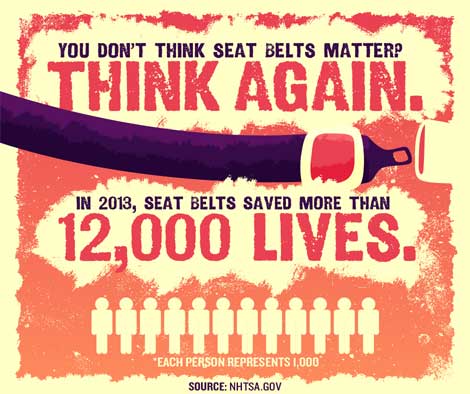
Click It Or Ticket DAY & NIGHTMonday, May 18, 2015 designates the beginning of a two week National Seat Belt Enforcement Mobilization. Law enforcement officers will be looking for motorist not wearing their seat belts in the annual Click It or Ticket campaign. Always wearing your seat belt is not only a good idea, but is required by law. This year the National Highway Traffic Safety Administration is putting the spotlight on night driving as a large percentage of fatalities occur between 6 p.m. – 5:59 a.m. that involve failure to buckle in.

So always, always, always wear your seat belt. It doesn’t matter…

  • What type of vehicle: Whether it’s a compact car or a pickup truck, put on your seat belt!
  • Where you are sitting: Front seat or back seat, always buckle up!
  • Where you are driving: In the city or the country, safety belts are a must!

To learn more, visit www.nhtsa.gov/ciot.

Safety for Two Wheels

Motorcycle & Bicycle Awareness

May kicks off both Motorcycle Safety Awareness Month & Bicycle Safety Month. With only two wheels, motorcycles and bicycles are less stable and require the rider to have great handling ability. They are much smaller and harder to see than other vehicles on the road. Consequently, motorcycles and bicycles are more easily hidden or missed by other drivers. Also, they don’t have the same protection as an automobile driver, making any type of collision or wipeout serious or fatal.

What you may not know is bicyclists and motorcyclists have the same right to ride on the road as other vehicles. Furthermore, they are subject to the majority of laws that all other drivers are required to follow. As a driver, don’t forget to always check your blind spots every time you change lanes or prepare to make turn. Remember to consider a bicycle lane the same as other traffic lanes. Also, do not try to pass a bicyclist until it is safe to do so allowing ample room between your vehicle and the rider.

As a motorist sharing the road with others, it’s crucial your defensive driving strategies include being aware of other types of vehicles in your driving environment.