The OTHER Distracted Driving

Eat it … But Not While You’re Driving

distracted-driving_7

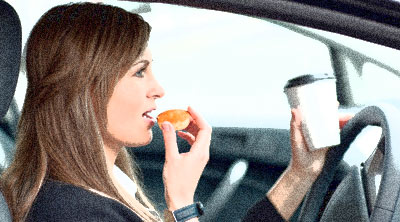
You’ve heard a thousand times the dangers of talking on your cell phone while driving, or the perils associated with texting and driving.  But we bet a lot of you are guilty of another dangerous distraction: EATING while driving.  And we’re sure you know not to “drink and drive,” but that’s true for ANY kind of beverage, not just alcohol. Soft drinks are on the top ten list of most dangerous things to consume while trying to drive.  Seriously!

The National Highway Traffic Safety Administration (NHTSA) revealed some pretty startling statistics for such a common activity among American drivers.  According to NHTSA’s study in 2009, eating while driving increases the odds of an accident by 80% and accounts for 65% of near miss accidents.  Yikes!

Some of the top offenders for increasing the risk of an accident include hamburgers, doughnuts with cream or jelly filling, fried chicken, tacos and — ranked number one — coffee.  The truth is, anything that is going to take your attention away from the road is considered distracted driving.  You’re already averting your eyes from the road in the food-to-mouth process, and then, just imagine …  You bite into that juicy burger and suddenly you’ve got mustard dripping down your crisp white shirt.  Or a big glop of jelly you weren’t able to stop oozing out of your savory treat in time.  Fried chicken is super greasy, and tacos pretty much disassemble themselves!  Coffee is an obvious one – hot liquid spillage is always a catastrophe, and the fact that coffee “to go” is often served in flimsy cups only makes matters worse, contributing to this beverage being labeled the most dangerous item to consume while driving.

In today’s busy world, we’re always looking for ways to save time and it’s easy to fall into the trap of grabbing a bite to eat on the run.  But please – if you must grab food on the run, pull into a parking lot or wait until you reach your destination to enjoy.

Holi-Dazed

Don’t Lose Your Cool This Winter

aggressive-driver-webThe holiday season is a stressful time of year for many, and the roadways may get more congested than ever.  Frustration and anger can make for some nasty driving behavior, so if you’re feeling like steam is about to blow out your ears, TrafficSchool.com has 5 pointers for maintaining your calm to avoid becoming an aggressive driver (and to avoid a ticket!)

1) Relaaaaaxxx – taking slow, deep breaths and concentrating on your breath can help calm down angry feelings.  Listening to a calming CD can also curb agitation. Or put your favorite music on to make your car time more enjoyable.

2) Drive the speed limit – fewer accidents occur when vehicles are traveling at or about the same speed.

3) Find alternate routes – You may find a route that is less congested, more enjoyable, or at least a nice change from your usual everyday trips.

4) Take advantage of public transportation when you can and avoid dealing with traffic altogether!

5) Just be late.  If you are not going to make it to your destination in time, just accept that you will be late.  Simple as that.  Better to arrive late safely than to put yourself and other drivers at risk.


‘Tis The Season!

How to Keep Your Holidays Merry and Bright

cocktails_berries-300x225

’Tis the season for holiday celebrations!  But hold on there…we want to remind you ’tis also the season to be extra cautious on roadways.  December is National Drunk and Drugged Driving Prevention month, and what better time to address dangers of driving intoxicated than now?  This month abounds with lots of food and lots to drink.  We know it’s easy to get caught up in all the cheer and merriment of the holiday season, and that’s why it’s a really good time to remember the consequences of driving impaired.  According to the National Highway Traffic Safety Administration (NHTSA), data shows that the holiday season is a particularly dangerous time on the roadways:

  • In 2011, 760 people lost their lives as a result of drunk-driving-related crashes during the month of December alone.
  • Nearly 30% of the 14,318 December crash fatalities from 2007 to 2011 involved drivers with blood alcohol concentrations of .08 grams per deciliter or higher.

It may be easy to tune statistics out, but take a moment to really visualize the risks of drunk and buzzed driving and how you’ll be affected.  A DUI conviction stays on your record indefinitely, affecting your home life, your work, and just about every other aspect of your life.  Being convicted of a DUI comes at great cost: monetary loss due to legal fees, lost wages, and potential civil lawsuits — not to mention a significant increase in your auto insurance rates.  If you believe putting yourself at risk isn’t that big of a deal, then at least think of the innocent people who could be injured or killed because of YOUR bad decision.  Living with the aftermath of such incidents is devastating.  How could you ever make it up to them?  No matter how you look at it, driving under the influence of even ONE drink is not worth the risks.

The best decision you can make is one you make before partaking in any consumption of alcohol.  If you are attending a party or event where alcohol will be present, decide beforehand to either abstain from drinking completely or to abstain from driving.  You must decide on your plan BEFORE you begin enjoying the festivities, especially if you tend to have trouble abstaining even when you know you need to drive.  Once alcohol hits your system, you’re a lot more likely to make poor decisions.

If you’re going to be with a group of people, select a designated driver.Print  There are several organizations that participate in a designated driver program, with many establishments offering incentives like complimentary non-alcoholic beverages for the DD.  Who doesn’t love FREE?

In case you can’t find a designated driver, or if your designated driver fails to maintain sobriety, have a taxi cab number on hand to call at the end of the night to pick you up and drop you off.  It’s a lot less expensive than a DUI.

Now … go drink and be merry!  Just remember – your drink doesn’t have to be alcoholic, and never should be if you plan to drive.
The Fall in Gas Prices

What Does the Future Hold?

fall-in-gas2-80

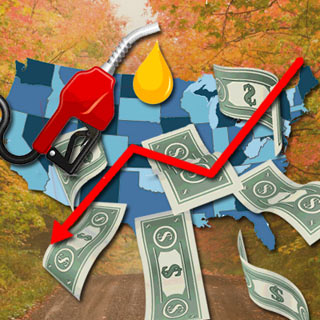
The Fall season is upon us, and just like the autumn leaves, gas prices are coming down.  Yes, go ahead and let out that sigh of relief, we’ve felt the outrageous gas increase over the summer as well.

AAA reports unleaded gas is now averaging $3.34 a gallon, the lowest national average since the beginning of the year.  Lundberg Survey, Incorporated (LSI), an independent market research company specializing in U.S. petroleum marketing, announced its latest findings on September 20th.  Charleston, SC claimed the cheapest gas price at $3.14 a gallon, while drivers fueling up in San Francisco were still shelling out a little over $4 a gallon. Though gas prices aren’t what they used to be, we don’t think anyone’s complaining about the overall declining prices.  Some estimates even predict gas prices could drop below $3.00 per gallon by the end of the year – the first time since December of 2010.

One reason behind the significant decrease is from the usual seasonal drop in gas prices.  According to AAA, factories are making seasonal adjustments by switching from summer-grade blends of gasoline to winter-blends.  Winter-blends are less expensive, thus costing the consumer less as well.

Unfortunately, other industry insiders have a slightly more grim outlook for the future of gas prices, believing that they will never dip below $3 a gallon again.  Experts forecast the future of gas prices to rise and fall in association with current events, such as the United States’ relations with the Middle East.

Either way, motorists should do what they can to make their vehicles more fuel-efficient.

Stay tuned for our blog posts full of tips on how to make your gas “go the extra mile.”  We’ll clue you in on simple ways you can make your vehicle more fuel efficient, helping you make your car last longer and keep more money in your wallet!

Baby Boomers vs Millennials

Who’s the Better Driver?better_driver_web

A question I’m sure most ‘Boomers’ are quick to answer, “I am.”  But, before you rule out the possibility that someone younger than you, with much less driving experience than you could possibly be a better driver than you, let’s take a look at a few things.

Bad driving habits are the number one downfall for most adult drivers.  Because of the years of experience behind the wheel, they generally hone the attitude, “Well, I’ve been doing it for so long, and I haven’t gotten into an accident yet.”  But why even risk it?    The problem with habits is that they’re hard to break, even if they’re bad for you or those around you.

According to a study conducted by State Farm Insurance, 65% of adults surveyed talk on the phone while driving, even though 94% of them prohibit their teenagers from doing so.  Another bad habit a lot of Boomers have is drowsy driving and also driving while in a rush.  Millennials are least likely to possess these awful habits if they haven’t already picked them up from a parent.

However, the real question here is whether experience and judgment overrules good eye-hand coordination and fast reaction time.  Well, reports still show that adults are far better equipped to handle the complexities of the road in any situation than Millennials, despite all that comes with old(er) age.  But one thing’s for sure, rules and laws change, so Boomers should brush up on their skills just like Millennials anyway.

Not Your Ordinary DIY Car Wash

Get That Professional Look All on Your Own

DIY_Car_Wash
No one likes a dirty car, and sometimes a simple car wash just doesn’t cut it. So, we scoured the internet for some of the most unconventional methods to washing your car and keeping it cleaner much longer.

Hair conditioner, not just for your hair:
Hair conditioner that contains lanolin will give your car that extra shine it deserves. It will leave your car with that freshly waxed look people spend so much money on.

Pass me a Cola please:
Getting rid of those windshield streaks isn’t always the easiest. But, by pouring cola over the glass, the bubbles in the cola will fizz away the grime. Just be sure to wash the cola off thoroughly and put a towel along the bottom of the windshield to protect the paint.

The No-Wax Washer:
Add 1 cup kerosene to a 3-gallon bucket filled with water and then sponge the solution over your car. The next time wet weather is in the forecast, the rain will bead up and roll right off of your car, reducing the chances of rust.

A couple more helpful tips:
Washing your car when it is too hot can result in soapy splotches and deposits.
Try to avoid air-drying, it can leave watermarks on the exterior.

At the Pump

What The Gas Stations Won’t Tell You

gas_pump
Did you know? Gas stations earn on average between 10 and 15 cents on a gallon of gas. But, they earn the least when prices are highest. When the cost of fuel rises, gas stations must reduce their profit margin in order to stay in competition. So, they actually fear gas increase just as much as you do.

Did you know? Oil companies spend lots of money explaining why their gas is better than the competitions. But in reality, one gallon of gas is as good as the next. Additives help to clean your engine, but what the companies don t tell you is that all gas has them. The government requires that detergents be added to all gasoline to help prevent fuel injectors from clogging.

Did you know? You don’t even need gas to run your car. While it is true that all cars run on gasoline, it is also fact that not all cars need gasoline to run. In fact, 6 million cars on the road today (mostly from U.S. manufacturers and built since 1998) are flexible fuel vehicles that can run on E85, a fuel that is 85 percent ethanol and only 15 percent gas.

Don’t Wait to Have “The Talk”

Is It Time To Hand Over Those Keys?

keys3

When is the right time to tell a senior loved one that their days behind the wheel are lessening with each passing day?

According to statistics, there are approximately 33 million drivers over the age of 65 regularly operating a motor vehicle in the United States. The majority of these motorists are injured daily from driving-related accidents; some even killed.

Because of medical complications, disabilities, a decline in vision and cognitive functions, the risk of vehicular fatalities increases significantly after the age of 75.

Although these are plenty of reasons to be off the road completely, telling someone who has been driving for as long as they can remember isn’t exactly the easiest conversation to have. In fact, according to a new study, published in the Journal of General Internal Medicine, from the University of Colorado School of Medicine and the CU College of Nursing, clinicians often wait too long before having “the talk.”

Based on a study conducted by Dr. Marian Betz, researchers found that most of the more mature and seasoned drivers were open to being approached earlier with driving retirement. It allows them more than enough time to process and prepare in the event they become incapable to drive.

Several states have considered instituting an elderly driving law, requiring individuals to be retested behind the wheel after a certain age.

Seeing Red

Road Rage: Do You Have It In You?

s1roadrage_web_2Road rage. We all have a little bit in us. No? Remember that time when the vehicle in front of you was driving so obnoxiously slow that if you got out of your car and walked, you’d probably make it to your destination a lot faster? Or how about the driver who continuously slammed on his breaks causing you to do the same, for absolutely no reason at all? Yes, I’m sure you remember moments like this. You may even remember how you felt, the choice of words you used, and the amount of frustration endured. However, some of us choose to take this anger and act upon it in ways that presents not only self-danger, but danger to other motorists on the road as well.

Road rage is defined as aggressive or angry behavior by a driver of an automobile or other motor vehicle. Such behavior might include rude gestures, verbal insults, deliberately driving in an unsafe or threatening manner, or making threats. Road rage can lead to altercations, assaults, and collisions which result in injuries and even deaths.

So, if you are ever confronted with an aggressive driver, what should you do?

1. Avoid direct eye contact with a driver who appears to be agitated. Many people associate eye contact with a challenge or threat. Even a friendly smile can be misinterpreted as a sarcastic threat.

2. Put Your Pride Aside. Do not challenge them by speeding up or attempting to hold-your-own in your travel lane.

3. Gestures. Ignore gestures and refuse to return them.

4. Report Serious Aggressive Driving. You or a passenger may call the police. But, if you use a cell phone, pull over to a safe location.

Aggressive driving contributes to 56 percent of all fatal car crashes, so next time think twice before you react!

(Source: National Highway Traffic Safety Administration)

Traffic Pollution and Noise Linked to Heart Disease

The Dangers Of Traffic Pollution

Most drivers, including myself tend to blindly jump in the car and take off to wherever it is the destination takes us with no real regards to the impact that our vehicles have on the earth we live in. Yes, I know with busy lives comes busy schedules and much transportation to and from. Nonetheless, we could still do a little something to aide in the efforts of keeping the earth intact. Simply being conscious and aware of what’s going on with the environment is a start. Those of you like me who drive pretty much everywhere, as an alternate mode could take public transportation, carpool, and even ride your bike to work. Just a day or two out of the week would help a great deal. With the recent celebration of Earth Day, the one day out of the year where the community becomes more involved in the preservation of the environment, by participating in a variety of events which bring attention to the world. Created to be an environmental “teach-in” for educating people on the impact they have on the environment and what they could do to make it better, Earth Day reaches more than one billion people in more than 175 countries around the world, inspiring awareness of the environment, spreading appreciation for the Earth and educating people on how they too can help with saving our earth.

Drivers Ed Direct, a California based driving school, compiled a list of some of the best environmental-friendly ‘Green Cars’ to ever roam the roadways. That list included: the Toyota Avalon Hybrid, the electric plug-in Honda Fit EV, the spacious Volkswagen Jetta Hybrid, and both the Ford C-Max Energi and the Ford Focus Electric. Still in all, the most successful gas-electric hybrid on the market has got to be the Toyota Prius. It was the first mass-produced hybrid in the country. On a full charge, the Plug-in can travel for roughly 11 miles in electric mode, getting an equivalent of 95 MPG. It then switches to hybrid mode, for which it is rated at a 50 MPG.
Traffic pollution
Aside from saving on gas, and spewing off fewer fumes, who knew that these eco-friendly vehicles could also be a vessel in saving lives? Check this story out:

In a research study which was based on data from the German Heinz Nixdorf Recall Study concluded that traffic pollution and noise are linked to heart diseases. Exposure to traffic pollution and noise can in the long run lead to atherosclerosis, according to the study. The long-term exposure to particle pollutants of 4,814 participants who live nearby roads with high traffic volume was calculated. The study also took account of road traffic noise and its effect on cardiovascular diseases, as recorded by validated tests. The test group’s level of atherosclerosis was then evaluated by measurement of vascular vessel calcification in the thoracic aorta by computed imaging. Results showed that in 4,238 subjects, small particulate matter and proximity to major roads were both associated with an increasing level of aortic calcification. For every increase in particle volume up to 2.4 micrometers, the degree of calcification increased by 20.7% and went up an extra 10% for every 100 meter of proximity to heavy traffic.

Furthermore, the study also found an increase in atherosclerosis associated with night time noise. “These two major types of traffic emissions help explain the observed associations between living close to high traffic and subclinical atherosclerosis. The considerable size of the associations underscores the importance of long-term exposure to air pollution and road traffic noise as risk factors for atherosclerosis,” concluded Dr. Hagen Kälsch from the West-German Heart Centre in Essen. Fine particle matter and traffic noise are believed to act through similar biologic pathways, thereby increasing cardiovascular risk. They both cause an imbalance in the autonomic nervous system, which feeds into the complex mechanisms regulating blood pressure, blood lipids, and glucose level.