Traffic Pollution and Noise Linked to Heart Disease

The Dangers Of Traffic Pollution

Most drivers, including myself tend to blindly jump in the car and take off to wherever it is the destination takes us with no real regards to the impact that our vehicles have on the earth we live in. Yes, I know with busy lives comes busy schedules and much transportation to and from. Nonetheless, we could still do a little something to aide in the efforts of keeping the earth intact. Simply being conscious and aware of what’s going on with the environment is a start. Those of you like me who drive pretty much everywhere, as an alternate mode could take public transportation, carpool, and even ride your bike to work. Just a day or two out of the week would help a great deal. With the recent celebration of Earth Day, the one day out of the year where the community becomes more involved in the preservation of the environment, by participating in a variety of events which bring attention to the world. Created to be an environmental “teach-in” for educating people on the impact they have on the environment and what they could do to make it better, Earth Day reaches more than one billion people in more than 175 countries around the world, inspiring awareness of the environment, spreading appreciation for the Earth and educating people on how they too can help with saving our earth.

Drivers Ed Direct, a California based driving school, compiled a list of some of the best environmental-friendly ‘Green Cars’ to ever roam the roadways. That list included: the Toyota Avalon Hybrid, the electric plug-in Honda Fit EV, the spacious Volkswagen Jetta Hybrid, and both the Ford C-Max Energi and the Ford Focus Electric. Still in all, the most successful gas-electric hybrid on the market has got to be the Toyota Prius. It was the first mass-produced hybrid in the country. On a full charge, the Plug-in can travel for roughly 11 miles in electric mode, getting an equivalent of 95 MPG. It then switches to hybrid mode, for which it is rated at a 50 MPG.
Traffic pollution
Aside from saving on gas, and spewing off fewer fumes, who knew that these eco-friendly vehicles could also be a vessel in saving lives? Check this story out:

In a research study which was based on data from the German Heinz Nixdorf Recall Study concluded that traffic pollution and noise are linked to heart diseases. Exposure to traffic pollution and noise can in the long run lead to atherosclerosis, according to the study. The long-term exposure to particle pollutants of 4,814 participants who live nearby roads with high traffic volume was calculated. The study also took account of road traffic noise and its effect on cardiovascular diseases, as recorded by validated tests. The test group’s level of atherosclerosis was then evaluated by measurement of vascular vessel calcification in the thoracic aorta by computed imaging. Results showed that in 4,238 subjects, small particulate matter and proximity to major roads were both associated with an increasing level of aortic calcification. For every increase in particle volume up to 2.4 micrometers, the degree of calcification increased by 20.7% and went up an extra 10% for every 100 meter of proximity to heavy traffic.

Furthermore, the study also found an increase in atherosclerosis associated with night time noise. “These two major types of traffic emissions help explain the observed associations between living close to high traffic and subclinical atherosclerosis. The considerable size of the associations underscores the importance of long-term exposure to air pollution and road traffic noise as risk factors for atherosclerosis,” concluded Dr. Hagen Kälsch from the West-German Heart Centre in Essen. Fine particle matter and traffic noise are believed to act through similar biologic pathways, thereby increasing cardiovascular risk. They both cause an imbalance in the autonomic nervous system, which feeds into the complex mechanisms regulating blood pressure, blood lipids, and glucose level.

The New DUI: Driving While Intexticated

For as long as I can remember, there’s news almost daily about the tragic death(s) caused by an impaired driver. While the rate of fatal deaths due to DUI has actually been decreasing sharply over the last two decades, today’s drivers have seemingly chosen a new deadly form of DUI: Driving While Intexticated.
Texting while driving decreases reaction times.
Ironic in their nomenclature, smart phones are increasingly making drivers incredibly stupid. For the first time in history, drivers everywhere are making the conscious choice to drive several seconds at a time with their head down. This is no LOL matter.

Ponder this:

  • Compared to a 12% decrease of reaction time for buzzed drivers driving at the legal blood-alcohol limit, the reaction time of drivers texting while driving decreases by a whopping 35%. Intexticated drivers are almost 3 times slower to react that intoxicated drivers.
  • About 80% of drivers use their cell phones when on the road, and 60% of novice drivers between the ages of 18-24 own up to pounding away on an iPhone or Android keyboard while behind the wheel.

The Future of Crash Text Dummies

The Texting and Driving Dilema

So how will state governments wage war on drivers driving under the influence of text? No one is sure, but looking to the past may give us an idea. Decades ago, drunk driving was much more rampant per capita. In order to get the rate of drunk drivers under better control, concerned agencies used a two prong attack:

  1. Influence the public to perceive driving under the influence with harsher eyes (through PSA’s and in-school educational programs)
  2. Increase the punishment for those getting a DUI (steeper fines, revoking licenses, and longer jail time)

A similar strategy might have to be employed to thwart the increasing problems texting and driving is causing. The public perception campaign is already under way. Just search ‘Texting and Driving’ on Youtube and you’ll see what I mean. Though punishment has increased for those who choose to drive phone-in-hand, the common discipline is a slap on the wrist or an inexpensive citation. Will it take stiffer punishment to get drivers to leave the phone alone? Consider a common strategy used by high school teachers dealing with cell phones in the classroom – “Use it and Lose it”. Though an officer confiscating a phone because he saw you texting may seem overboard, I guarantee we’d see a lot more hands on 10 and 2 instead of on the QWERTY.

Sources: timesonline.co.uk, tennessean.com, iii.org, washingtonpost.com

Drive as I Say, Not as I Do

Are You The Reason For Your Teen’s Bad Driving Habits?
Monkey See, Moneky Do

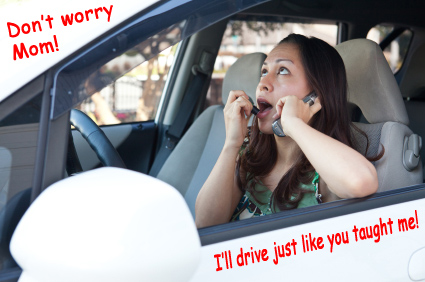
As a parent of a new teen driver, your hopes are that they learn proper defensive driving techniques, while you continue to drill in the “Do’s and Don’ts” of the road, as well as bringing about safety awareness. However, what we fail to realize is that our teenagers are soaking up these life-long lessons by mimicking that in which they see, most times, that which is you! Adult drivers holding on to bad driving habits are complacent, and might not keep up with recent changes in the law. But don’t knock yourself down just yet. In most cases, adults aren’t even aware of these bad driving habits which in turn impact their teens without even realizing the reason behind it.

The most common mistake among adult drivers is thinking you know it all. Because of the experience and the amount of years behind the wheel, most adults feel as if they are immune from any danger on the road. This could not be further from reality. Truth be told, accidents occur, and even if you have never been in or caused an accident before, it could still happen to you, perhaps caused by the at-fault novice driver.

Another mistake teens see their parents doing while behind the wheel is failing to use blinkers for signaling. We don’t need to get into the specifics on just how dangerous not signaling can be, despite its simplicity and readily accessible location, but let’s just say that it should be one of the most used features on your vehicle and without it not only causes much confusing, but a lot of collisions as well. I mean how exactly do you expect to teach your children the proper way to drive, when you yourself is not obeying a traffic law as simple as this?

According to CNN, a survey of over 1,700 teens admitted that they had performed risky activities, such as speeding, talking or texting on their cell phones, or not wearing their seat belts while operating a motor vehicle. The study also found that more than half of those teenage drivers had observed their parents engaging in similar behaviors while driving. Dave Melton, a driving safety expert with Liberty Mutual, stated that, “These findings highlight the need for parents to realize how their teens perceive their actions.” He also added, “Your kids are always observing the decisions you make behind the wheel, and in fact have likely been doing so since they were big enough to see over the dashboard…You may think you only occasionally read a text at a stop light or take the odd thirty-second phone call, but kids are seeing that in a different way. Answering your phone once while driving, even if only for a few seconds, legitimizes the action for your children and they will, in turn, see that as acceptable behavior.”

Out of the 94% of teenage drivers who admitted to speeding, 88% claimed that they had witnessed their parents breaking the speed limit before. According to a survey conducted by Writer Suzanne Kate, 91% of teenagers said they had witnessed their parents talking on a cell phone while driving, with 78% confessing that they had texted while driving, while 59% of parents reportedly had done so. Shockingly, adults were more likely than their children to not wear seatbelts.

Bottom line, teens who engage in dangerous driving most likely learned their bad driving skills from their parents. Parents, not only is it your ultimate duty, but it is imperative that as adults you demonstrate good driving behavior from the very beginning so that new drivers understand that safe driving rules apply to everyone equally. It’s time to make a change. It starts with you! Your teen’s life just might depend on it.