Communication on the Road
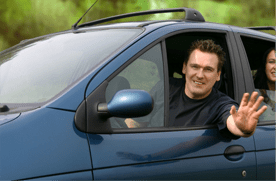 Communication with other drivers on the road is very important. Using standard equipment on your car, like turn signals, brake lights, hazard lights, headlights, and your horn, are all simple yet effective ways of telling everyone else what you intend to do next. Communication on the road can also be characterized by conveying your intentions to others through eye contact, body language, and hand signals, while simultaneously picking up on cues from other drivers and pedestrians.
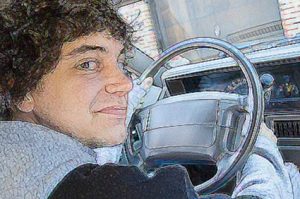
Non-verbal interaction with other road users can help make the roadways much safer. For instance, you may notice another driver continuously looking over their shoulder. This is usually a good indication that they want to change lanes, and you can help by giving them the space they need. Or perhaps you have stopped at an intersection and a pedestrian is at the street corner. Making eye contact and a simple nod of your head is often enough to tell the pedestrian, “I see you are going to cross the street.”

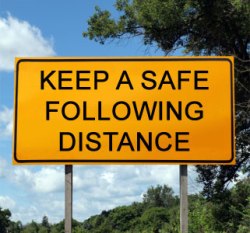 Allowing yourself proper following distance between your car and the car ahead of you can be difficult to visually estimate. A good way to gauge a suitable gap is to use the “Three-Second Rule.” Here’s how it works: when the car or truck in front of you crosses a certain fixed object on the side of the road (like a sign or tree), start counting, “one thousand one, one thousand two, one thousand three.” You should not cross that same point for three seconds. Under normal conditions it takes about 2-3 seconds to completely stop when traveling at speeds between 35 mph to 65 mph; so with a three-second space cushion, you should have enough time to react and brake when something happens up ahead.

 A big part of defensive driving is scanning the road. Not just looking for hazards ahead of you, but also being aware of what is going on to the sides and behind you as well. When scanning, your eyes are continuously moving from side to side, ahead and in your rear-view mirrors. Take short quick glances to take in the big picture and be aware of and regulate potentially hazardous situations before you find yourself in a predicament.
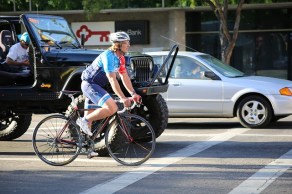 May kicks off both Motorcycle Safety Awareness Month & Bicycle Safety Month. With only two wheels, motorcycles and bicycles are less stable and require the rider to have great handling ability. They are much smaller and harder to see than other vehicles on the road. Consequently, motorcycles and bicycles are more easily hidden or missed by other drivers. Also, they don’t have the same protection as an automobile driver, making any type of collision or wipeout serious or fatal.
 Furthermore, they are subject to the majority of laws that all other drivers are required to follow. As a driver, don’t forget to always check your blind spots every time you change lanes or prepare to make turn. Remember to consider a bicycle lane the same as other traffic lanes. Also, do not try to pass a bicyclist until it is safe to do so allowing ample room between your vehicle and the rider.
 Road safety starts with you, the driver. Here are a few defensive driving pointers to help you stay safe and sound while on the go.

 Right Side of the Road