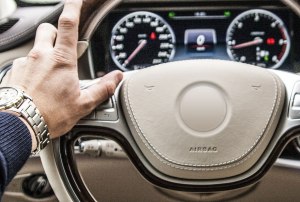
Alright, so here’s the scoop: if you’re driving in California, your wheels gotta come equipped with a working horn that can make noise audible from at least 200 feet away. But, and it’s a big but, that noise can’t be crazy loud or downright annoying.
Now, we all know how it goes when you’re stuck in traffic or dealing with less-than-stellar drivers. Honking becomes a bit of a reflex, right? Well, turns out, the California Vehicle Code (CVC 27001(a)) has a little nugget of wisdom – you should only hit that horn when it’s genuinely needed for safety. In simpler terms, angry honks because someone cut you off might just earn you a ticket.
Keeping tabs on how often you unleash your horn isn’t just about sticking to the rules; it’s about creating a laid-back and considerate vibe on the roads. Let’s aim for some peace and quiet out there!
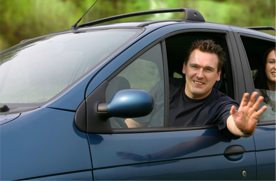 Communication with other drivers on the road is very important. Using standard equipment on your car, like turn signals, brake lights, hazard lights, headlights, and your horn, are all simple yet effective ways of telling everyone else what you intend to do next. Communication on the road can also be characterized by conveying your intentions to others through eye contact, body language, and hand signals, while simultaneously picking up on cues from other drivers and pedestrians.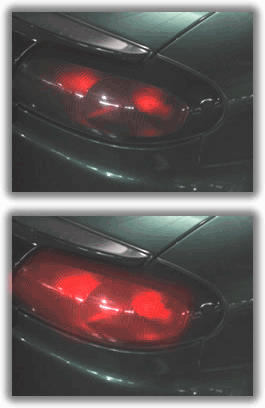

 Allowing yourself proper following distance between your car and the car ahead of you can be difficult to visually estimate. A good way to gauge a suitable gap is to use the “Three-Second Rule.” Here’s how it works: when the car or truck in front of you crosses a certain fixed object on the side of the road (like a sign or tree), start counting, “one thousand one, one thousand two, one thousand three.” You should not cross that same point for three seconds. Under normal conditions it takes about 2-3 seconds to completely stop when traveling at speeds between 35 mph to 65 mph; so with a three-second space cushion, you should have enough time to react and brake when something happens up ahead.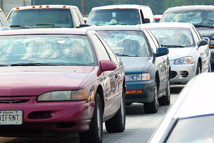

 Right Side of the Road