
The Golden Rule of Driving

Courtesy is Key

5662967723_c2aec1ed96_o

You know that Golden Rule, “Treat others how you would like to be treated?”  Well, that applies to driving too.  Be a courteous driver just as you would like other drivers to be courteous to you.  When you lead by example with your patience and mindfulness, you can actually reduce your OWN frustration behind the wheel, as well as other drivers’ frustration.  Follow TrafficSchool.com’s tips to maintain the level of courtesy necessary to drive safely and not upset other drivers:   

  • STAY OFF YOUR PHONE!  Unless it is an emergency.
  • If you prefer to drive at a slower pace, move into the right lane.  If it’s a single lane road, look for a turnout where you can pull over so faster moving vehicles can pass you.
  • When traveling with kids, make sure you have plenty of items or toys to keep them occupied so you can focus on driving.
  • Don’t weave in and out of traffic lanes, and when you are changing lanes, always use your turn signal.
  • Avoid following other drivers too closely or “tailgating.”

Simple, right?  You don’t want to be part of a chain reaction of bad driving because you’re taking your frustration out on the road and on other drivers.  

Be the start of a courteous chain reaction instead; the Golden Rule is called “Golden” for a reason!  Go for gold!
The OTHER Distracted Driving

Eat it … But Not While You’re Driving

distracted-driving_7

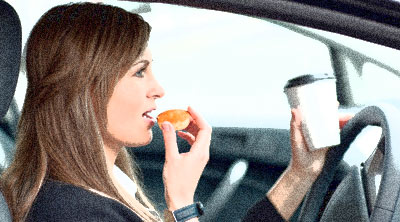
You’ve heard a thousand times the dangers of talking on your cell phone while driving, or the perils associated with texting and driving.  But we bet a lot of you are guilty of another dangerous distraction: EATING while driving.  And we’re sure you know not to “drink and drive,” but that’s true for ANY kind of beverage, not just alcohol. Soft drinks are on the top ten list of most dangerous things to consume while trying to drive.  Seriously!

The National Highway Traffic Safety Administration (NHTSA) revealed some pretty startling statistics for such a common activity among American drivers.  According to NHTSA’s study in 2009, eating while driving increases the odds of an accident by 80% and accounts for 65% of near miss accidents.  Yikes!

Some of the top offenders for increasing the risk of an accident include hamburgers, doughnuts with cream or jelly filling, fried chicken, tacos and — ranked number one — coffee.  The truth is, anything that is going to take your attention away from the road is considered distracted driving.  You’re already averting your eyes from the road in the food-to-mouth process, and then, just imagine …  You bite into that juicy burger and suddenly you’ve got mustard dripping down your crisp white shirt.  Or a big glop of jelly you weren’t able to stop oozing out of your savory treat in time.  Fried chicken is super greasy, and tacos pretty much disassemble themselves!  Coffee is an obvious one – hot liquid spillage is always a catastrophe, and the fact that coffee “to go” is often served in flimsy cups only makes matters worse, contributing to this beverage being labeled the most dangerous item to consume while driving.

In today’s busy world, we’re always looking for ways to save time and it’s easy to fall into the trap of grabbing a bite to eat on the run.  But please – if you must grab food on the run, pull into a parking lot or wait until you reach your destination to enjoy.

The New DUI: Driving While Intexticated

For as long as I can remember, there’s news almost daily about the tragic death(s) caused by an impaired driver. While the rate of fatal deaths due to DUI has actually been decreasing sharply over the last two decades, today’s drivers have seemingly chosen a new deadly form of DUI: Driving While Intexticated.
Texting while driving decreases reaction times.
Ironic in their nomenclature, smart phones are increasingly making drivers incredibly stupid. For the first time in history, drivers everywhere are making the conscious choice to drive several seconds at a time with their head down. This is no LOL matter.

Ponder this:

  • Compared to a 12% decrease of reaction time for buzzed drivers driving at the legal blood-alcohol limit, the reaction time of drivers texting while driving decreases by a whopping 35%. Intexticated drivers are almost 3 times slower to react that intoxicated drivers.
  • About 80% of drivers use their cell phones when on the road, and 60% of novice drivers between the ages of 18-24 own up to pounding away on an iPhone or Android keyboard while behind the wheel.

The Future of Crash Text Dummies

The Texting and Driving Dilema

So how will state governments wage war on drivers driving under the influence of text? No one is sure, but looking to the past may give us an idea. Decades ago, drunk driving was much more rampant per capita. In order to get the rate of drunk drivers under better control, concerned agencies used a two prong attack:

  1. Influence the public to perceive driving under the influence with harsher eyes (through PSA’s and in-school educational programs)
  2. Increase the punishment for those getting a DUI (steeper fines, revoking licenses, and longer jail time)

A similar strategy might have to be employed to thwart the increasing problems texting and driving is causing. The public perception campaign is already under way. Just search ‘Texting and Driving’ on Youtube and you’ll see what I mean. Though punishment has increased for those who choose to drive phone-in-hand, the common discipline is a slap on the wrist or an inexpensive citation. Will it take stiffer punishment to get drivers to leave the phone alone? Consider a common strategy used by high school teachers dealing with cell phones in the classroom – “Use it and Lose it”. Though an officer confiscating a phone because he saw you texting may seem overboard, I guarantee we’d see a lot more hands on 10 and 2 instead of on the QWERTY.

Sources: timesonline.co.uk, tennessean.com, iii.org, washingtonpost.com